


Blood Angels: Nobility, Rage, and Tragedy

Updated: Jul 4

In the universe of Warhammer 40K, the Blood Angels hold a special place among the Space Marine Chapters. At first glance, they embody everything the Imperium can still produce that is noble, grand, and heroic. Their red armor, angelic wings, sculpted faces, golden symbols, and almost sacred aesthetic immediately set them apart from the other sons of the Emperor.
But behind that beauty lies a curse.
The Blood Angels are not merely magnificent warriors. They are also beings haunted by an inner rage, an uncontrollable thirst for blood, and the tragic memory of their Primarch, Sanguinius.
That contrast is what makes them so fascinating.
They are noble, yet cursed.They are angelic, yet savage.They are heroic, yet constantly on the edge of madness.
So why are the Blood Angels one of the most beloved Chapters in Warhammer 40K? Why does their story affect fans so deeply? And why does this faction blend beauty, violence, and tragedy so well?
The Blood Angels, Space Marines unlike any others
The Blood Angels are a loyalist Space Marine Chapter. Like all Adeptus Astartes, they are genetically enhanced warriors created to defend the Imperium of Mankind against xenos, heretics, daemons, and every horror the galaxy can produce.
But the Blood Angels do not feel like ordinary soldiers, even among Space Marines.
They have an almost divine aura. Their imagery evokes angels, martyrs, warrior saints, and tragic heroes. Where some Chapters focus on brutality, discipline, or cold military efficiency, the Blood Angels bring something more theatrical, more artistic, and more emotional.
Their aesthetic is instantly recognizable: red armor, golden ornaments, winged symbols, blood drops, noble faces, heroic poses, elegant swords, jump packs, and constant references to sacrifice.
They do not simply look as if they are going to war.
They look as if they are marching toward their destiny.

Sanguinius, the angelic Primarch
It is impossible to understand the Blood Angels without speaking of Sanguinius.
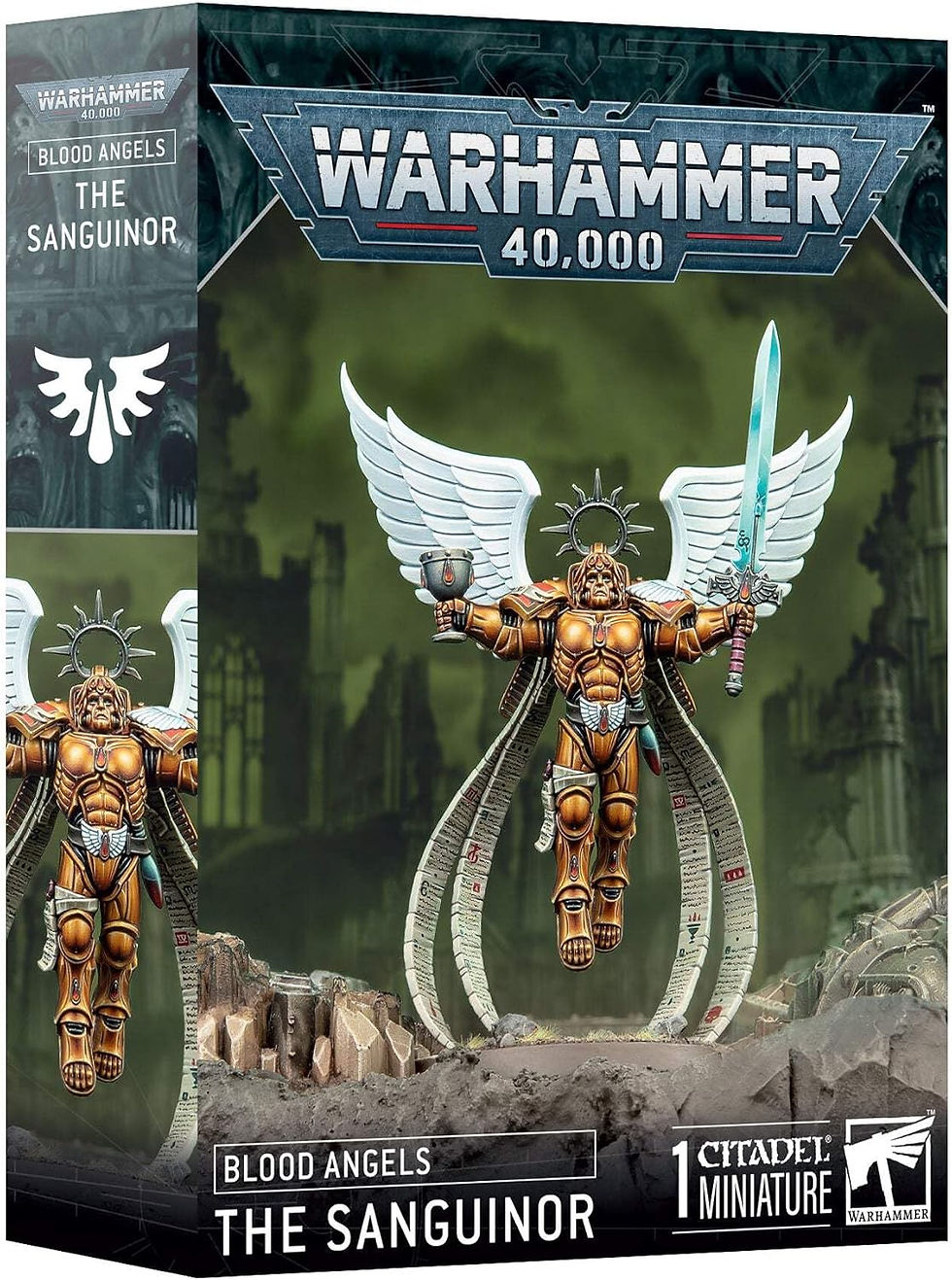
In the lore of Warhammer 40K, Sanguinius is one of the most beloved and respected Primarchs. An angelic figure, an exceptional warrior, a charismatic leader, and a deeply noble being, he embodies everything the Blood Angels still dream of becoming.
Sanguinius was not only powerful. He was beautiful, majestic, brave, and capable of inspiring absolute loyalty. His white wings and almost divine presence left a deep mark on the imagination of Warhammer 40K.
But his greatness cannot be separated from his tragic end.
During the Horus Heresy, Sanguinius faced Horus, the Emperor’s favorite son who had fallen to treachery. This duel is one of the most dramatic moments in the history of Warhammer 40K. Sanguinius knew he would probably die, but he stood against the master of the rebellion anyway.
That sacrifice defines the entire tragedy of the Blood Angels.
They are the sons of a dead angel.And since his death, they have carried his legacy as a blessing… but also as a wound.
A deeply tragic nobility
The Blood Angels fascinate people because they are not simply “the red Space Marines.” Their popularity comes from their dual nature.
On one side, they represent nobility. They love art, beauty, discipline, the perfection of movement, and heroic grandeur. They are not merely war machines. They try to rise above their own violence.
On the other side, they are consumed by a genetic curse that pulls them toward savagery.
This contrast is extremely powerful.
The Blood Angels want to be better than the monsters they fight. But they know that part of the monster already lives inside them. Their battle is therefore not only external. It is internal as well.
Every Blood Angel fights the enemy on the battlefield, but also fights himself.
That is what gives the Chapter such depth. Where other Space Marines may seem cold or unshakable, the Blood Angels are tragic because they can feel the fall waiting for them.
They know they may become what they hate.
The Red Thirst: the curse of blood
The first great curse of the Blood Angels is the Red Thirst.
This thirst represents their violent and almost uncontrollable attraction to blood and the brutality of combat. It pushes them toward savage fury, a desire to kill, bite, tear, and surrender to instinct.
For a Chapter so noble and refined, it is an intimate horror.
The Blood Angels are not proud of this weakness. They try to control it, hide it, and dominate it. But it is always there, like a shadow in their minds and in their blood.
On the battlefield, this curse can become a terrifying strength. A Blood Angel overtaken by the Red Thirst can become a fighter of incredible brutality, capable of throwing himself into the heart of the enemy with almost animal ferocity.
But that power comes at a price.
Because the more they give in to that rage, the closer they come to losing control.
That is the dark beauty of the Blood Angels: their greatest strength can also become their downfall.
The Black Rage: the memory of Sanguinius’ death
The second great curse of the Blood Angels is even more tragic: the Black Rage.
This madness transforms certain Blood Angels into warriors haunted by the final moments of Sanguinius. They no longer see the battlefield as it truly is. They psychically relive the death of their Primarch, as if they themselves were facing Horus during the Horus Heresy.
For them, the present disappears. The enemy before them becomes Horus. The battle becomes Sanguinius’ final fight.
These warriors are then assigned to the Death Company, one of the most iconic units of the Blood Angels.
The Death Company is tragic because it represents both honor and condemnation. These Space Marines are already lost. Their minds will not truly return. But before they die, they still have one final purpose: to turn their madness into a weapon.
They go to war clad in black, often marked with red crosses, like funeral angels launched into one last charge.
They are magnificent.They are terrifying.And they are doomed.
The Death Company, the ultimate symbol of the Blood Angels
The Death Company perfectly summarizes what makes the Blood Angels unique in Warhammer 40K.
They are not simple berserkers. They are broken heroes. Warriors who were once noble, now trapped in a nightmare vision, sent toward a glorious death because there is no other path left for them.
On the tabletop, the Death Company is instantly recognizable. Black armor, red crosses, aggressive poses, jump packs, melee weapons, dramatic energy. Visually, it carries the entire tragedy of the Chapter.
In a narrative campaign or a cinematic battle report, it offers enormous potential.
Imagine a squad of Blood Angels trying to hold a line against a Tyranid swarm. At the final moment, the Death Company is unleashed. The warriors scream the name of Sanguinius. They no longer see the monsters before them, but the shadows of a past they never lived.
That is exactly the kind of scene that makes Warhammer 40K so powerful.
A mixture of war, madness, sacrifice, and tragic grandeur.

The Blood Angels on the battlefield
On the tabletop, the Blood Angels are often associated with an aggressive, fast, and spectacular playstyle.
They naturally excel in close combat. Their identity pushes them toward heroic charges, assault units, jump packs, charismatic characters, and brutal strikes into the heart of the enemy army.
These are not Space Marines who simply want to stay at range and shoot for the whole game. The Blood Angels want to close the distance. They want to strike. They want to break the opponent in one decisive moment.
That does not mean they cannot use shooting, vehicles, or classic Space Marine strategies. But their personality truly shines when they are played as a shock force.
They often feel like a red blade cutting across the battlefield.
For players who enjoy spectacular actions, duels, risky charges, and dramatic reversals, the Blood Angels are an extremely appealing army.
A perfect faction for storytelling
The Blood Angels are also one of the best Space Marine Chapters for storytelling.
Their lore already contains everything needed to build powerful narratives: a noble lineage, a martyred Primarch, an inner curse, tragic heroes, a struggle against madness, an angelic aesthetic, and uncontrollable violence.
A Blood Angels campaign can easily become a true warrior tragedy.
You can imagine a Blood Angels force sent to save a besieged Imperial world. A squad trying to hide the first signs of the Black Rage. A captain refusing to abandon a doomed brother. A Death Company released in one final charge. A battle against Tyranids where every victory brings the heroes closer to their own fall.
With the Blood Angels, every battle can carry emotional weight. They do not fight only to win. They fight to remain themselves.

A magnificent aesthetic for painters
The Blood Angels are also very popular among painters and collectors.
Their red color scheme is powerful, readable, and instantly recognizable. It catches the eye on the gaming table and works extremely well in photos or videos. The contrast between the red armor, golden ornaments, black Death Company armor, and white or parchment details offers many visual possibilities.
The Blood Angels can be painted in a clean, bright, heroic style, or in a darker, more worn, bloodstained, and dramatic style.
The Chapter also allows painters to play with many symbols: blood drops, wings, chalices, skulls, parchments, halos, swords, decorated armor, and religious iconography.
It is an army that can look beautiful without losing its brutality.
And for a video channel or immersive battle report, the Blood Angels are perfect. The red stands out clearly on screen, the assault poses are dynamic, and their lore immediately gives dramatic intensity to combat scenes.
Dante, Mephiston, and the heroes of the Blood Angels
Another element that reinforces the popularity of the Blood Angels is their characters.
The Chapter has several iconic heroes, including Dante and Mephiston.
Dante is one of the greatest Chapter Masters of the Imperium. Ancient, respected, exhausted by centuries of war, he embodies the burden of duty. He is not merely a glorious hero. He is also a weary warrior who continues anyway because the Imperium still needs him.
Mephiston represents another side of the Chapter: power, fear, and mystery. His relationship with the curse of the Blood Angels makes him a fascinating, almost unsettling figure.
These characters show that the Blood Angels are not a uniform Chapter. They can be radiant, dark, heroic, monstrous, wise, or terrifying.
They all live in the shadow of Sanguinius, but each carries that legacy in his own way.
Blood Angels versus Tyranids: a natural rivalry
Among the most memorable enemies of the Blood Angels, the Tyranids hold a special place in the imagination of fans.
The contrast is perfect.
On one side, the Blood Angels: red warriors, noble, tragic, heirs of a dead angel, trying to preserve their humanity despite their thirst for blood.
On the other side, the Tyranids: a biological tide with no individual soul, driven by infinite hunger, devouring worlds and reducing all beauty to biomass.
It is an extremely visual and narrative opposition.
The Blood Angels embody nobility threatened by rage. The Tyranids embody pure, cold, absolute hunger. On the tabletop, this confrontation works immediately: red against monstrous flesh, angels against predators, tragedy against collective instinct.
For a Warhammer 40K campaign, it is one of the easiest conflicts to make cinematic.

Why do fans love the Blood Angels so much?
Fans love the Blood Angels because they combine several extremely powerful elements.
They are beautiful, but dangerous.They are noble, but cursed.They are heroic, but internally fragile.They are angels, but they can become monsters.
This duality is rare and very strong.
A beginner may love them for their appearance: red armor, wings, heroes, swords, jump packs, spectacular aesthetics. But a more advanced fan can find real narrative depth in them: the struggle against oneself, the fear of falling, the legacy of the dead father, sacrifice, rage, guilt, and honor.
The Blood Angels are not just a cool army.
They tell a tragedy.
And in Warhammer 40K, a good tragedy is sometimes worth more than a simple victory.
Blood Angels: nobility, rage, and tragedy
So how can we summarize the Blood Angels?
They are among the noblest Space Marines of the Imperium, but also among the most haunted. They carry the legacy of Sanguinius, one of humanity’s greatest heroes, but that legacy is stained with blood, pain, and madness.
They want to embody beauty, honor, and sacrifice.
But their own blood pulls them toward savagery.
That contrast is their strength.
The Blood Angels are not popular only because they have beautiful red armor. They are popular because they concentrate everything Warhammer 40K does best: a powerful aesthetic, memorable heroes, extreme violence, an intimate curse, and a tragedy that cannot be escaped.
They are the image of doomed greatness.
Red angels in a universe without paradise.
Heroes who win their battles, but must fight every day not to lose their souls.
That is why the Blood Angels fascinate so many fans.
Because they are not merely warriors.
They are a tragedy in power armor.


Comments