


Space Wolves: Space Vikings or War Wolves?

In the universe of Warhammer 40K, few Space Marine Chapters have an identity as instantly recognizable as the Space Wolves. One look at their grey-blue armor, beast pelts, runes, axes, fangs, and Fenris-inspired aesthetic is enough to understand that they are not Space Marines like the others.
Where the Ultramarines embody order, strategy, and classical Imperial discipline, the Space Wolves project something far wilder, more instinctive, and more mythological. They feel like warriors straight out of a Norse saga, thrown into a brutal future where war never ends.
So what are the Space Wolves, really?

Space Vikings? War Wolves? Heroic barbarians? Or one of the most complex and fascinating Chapters in Warhammer 40K?
The answer is more interesting than a simple cliché.
The Space Wolves: a Space Marine Chapter unlike any other
The Space Wolves are a loyalist Space Marine Chapter, but they have always occupied a special place within the Imperium. They do not feel like a perfectly standardized army coldly following every Imperial protocol. Their identity is older, more tribal, and more personal.
They come from Fenris, a brutal, frozen, and hostile world where only the strongest, cleverest, and toughest survive. That planet shapes their character long before they ever become Space Marines. The warriors recruited from the peoples of Fenris already carry within them a culture of clans, duels, sagas, hunting, survival, and honor.
That is what makes them so distinctive.
The Space Wolves are not merely genetically enhanced soldiers. They are warriors born from a world of legends, transformed into living weapons by the Imperium, yet never fully stripped of their roots.
They fight like Space Marines, but often think like saga heroes.
Why are they called “Space Vikings”?
The phrase “Space Vikings” is often used to describe the Space Wolves, and it is easy to see why.
Their aesthetic strongly recalls Norse imagery: wolf pelts, beards, long hair, runes, axes, packs, sagas, feasts, duels of honor, names inspired by Scandinavian sounds, and a warrior culture built around glory and remembered deeds.
On a Warhammer 40K tabletop, a Space Wolves army stands out immediately. It does not have the cold uniformity of some other Space Marine Chapters. Every miniature can seem to carry its own story: a trophy taken from a beast of Fenris, a scar, a talisman, a cloak, a customized weapon, a pack marking.
This visual dimension is one of the Chapter’s greatest strengths. The Space Wolves are not simply grey Space Marines with extra decorations. They tell a story at first glance.
They evoke war, but also myth.
That is exactly why the image of “Space Vikings” works so well: it captures, in a simple phrase, a very strong visual identity.

But the Space Wolves are not just Vikings
The problem is that this label can also flatten their depth.
To say that the Space Wolves are only Space Vikings is to forget that they are also Space Marines, defenders of the Imperium, genetically engineered warriors, veterans of galactic wars, and servants of a ruthless empire.
They do not exist in a simple Norse fantasy. They exist within the nightmare future of Warhammer 40K, a setting where humanity is besieged on all sides by xenos, heretics, daemons, and the horrors of the Warp.
Their Fenrisian culture gives them a unique personality, but their role remains that of an Imperial military force. They are sent where war becomes too intense for ordinary soldiers. They fight enemies that few humans could even look upon without breaking in terror.
That blend is what makes them so compelling.
They look like mythic warriors, yet they fight in a dark science-fiction universe filled with power armor, warships, heavy weapons, and campaigns spanning entire star systems.
So the Space Wolves are not just Vikings transplanted into space. They are mythic warriors locked inside a futuristic war machine.
War Wolves above all
The other great image associated with the Space Wolves, of course, is the wolf.
The wolf is everywhere in their identity: in their name, their symbols, their organization, their units, their trophies, their way of fighting, and their relationship to the pack.
But again, it should not be understood too simply.
The Space Wolves are not just Space Marines with an animal theme. The wolf represents the way they understand war. They do not fight like a line of faceless soldiers. They operate through instinct, loyalty, controlled aggression, and pack mentality.
A pack is not a disorganized mob. It is a living structure: fast, brutal, able to strike together and pull back at the right moment. That logic gives the Space Wolves their tactical personality.
They love close combat. They love the charge. They love feeling the enemy break under impact. But they are not stupid. Behind their savage exterior lies deadly military experience.
A Space Wolf may look brutal, but he is not just a mindless berserker.
He is a predator of war.
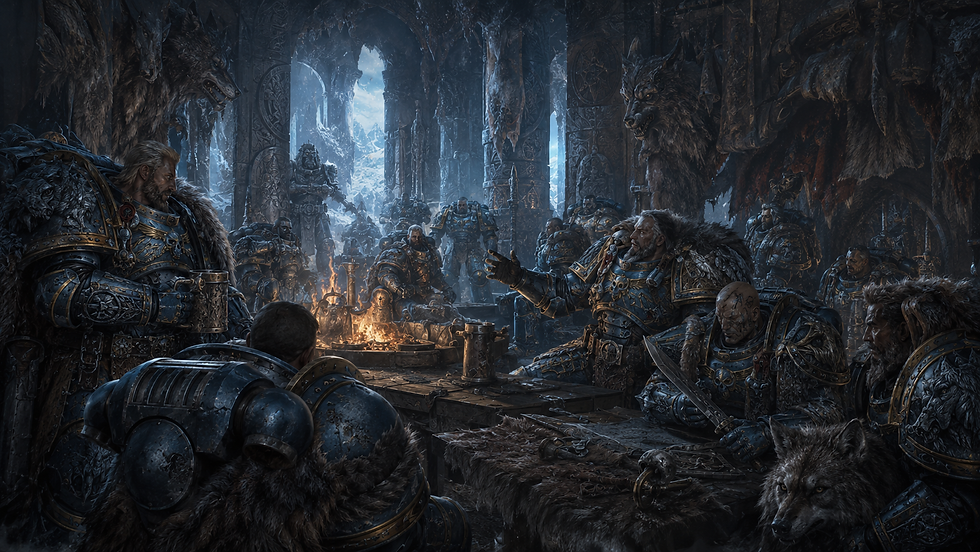
The power of contrast: savage, yet loyal
One of the most fascinating aspects of the Space Wolves is their relationship with the Imperium.
They are loyal, but not submissive. They defend humanity, yet they do not always resemble the ideal defenders the Imperial bureaucracy would like to control. They respect their traditions, their leaders, their sagas, and their own sense of honor.
That gives them a rebellious edge even within the loyalist camp.
They are not traitors. They do not serve Chaos. They do not seek to overthrow the Imperium. But they have their own temperament, their own pride, and their own way of judging what is right.
In a universe as authoritarian as Warhammer 40K, that independence makes them instantly interesting.
The Space Wolves are protectors of humanity, but they are not the polished, perfect image of the Imperial soldier. They are rougher, more direct, more instinctive. They can obey, but they never feel easy to tame.
And that is precisely what many fans love about them.
Leman Russ, the mythic father of the Space Wolves
It is impossible to talk about the Space Wolves without mentioning Leman Russ, their Primarch.
In the lore of Warhammer 40K, the Primarchs are almost mythological figures: part superhuman generals, part warrior demigods, part living tragedies. Leman Russ perfectly embodies the spirit of the Space Wolves: brute strength, loyalty, ferocity, pride, and legendary presence.
He is the founding father of the Chapter, the figure whose shadow still hangs over every warrior of Fenris.
Leman Russ matters not only because he is powerful. He gives the Space Wolves their epic dimension. He ties them to the great eras of Imperial history, ancient wars, the fractures of the Imperium, and the great dramas of the past.
For a player or reader, this gives the Chapter even more depth. The Space Wolves are not just a cool army with wolves and axes. They are the heirs of a legendary Primarch, marked by honor, violence, and destiny.
A perfect aesthetic for collectors
From a hobby perspective, the Space Wolves are an extremely attractive faction.
Their aesthetic allows for a great deal of customization. Where some Space Marine Chapters can appear highly uniform, the Space Wolves invite visual richness. You can add trophies, pelts, runes, special weapons, bare heads, tribal details, pack symbols, and veteran markings.
For painting, their grey-blue scheme works beautifully. It is recognizable, but still leaves room for variation. You can go for a clean heroic finish, or a darker, dirtier, more brutal style, with armor worn by snow, mud, blood, and battle.
The Space Wolves are also excellent for scenic basing and terrain work. They fit perfectly in icy environments, Imperial ruins, snow-covered battlefields, fortresses, besieged ships, or savage worlds.
For a video channel, a battle report, or a cinematic gaming table, they offer enormous visual potential.
An army made for storytelling

The Space Wolves are also incredibly strong from a narrative point of view.
Their culture of sagas naturally encourages storytelling. Every battle can become a legend. Every pack leader can have his own tale. Every duel can be framed as a moment of glory or tragedy.
They are a perfect faction for building a narrative Warhammer 40K campaign.
You can imagine a pack sent to an icy world to hunt a xenos threat. A Space Wolves force trapped inside a ruined Imperial city. An old hero seeking to fulfill one final oath. A rivalry between two leaders. A hunt for a daemon. A desperate defense against a Tyranid invasion. A war of vengeance against Chaos Space Marines.
With the Space Wolves, narrative comes almost by itself.
They are made for stories of war, loyalty, sacrifice, fury, and honor.
How do the Space Wolves play on the tabletop?
On the tabletop, the Space Wolves are often associated with an aggressive and dynamic playstyle.
They like to advance, charge, hit hard, and put pressure on the opponent. Their identity naturally pushes them toward close combat, heroic units, charismatic characters, and spectacular actions.
That does not mean they cannot shoot or use vehicles. Like many Space Marines, they still have a versatile foundation. But their personality truly shines when they are used like a hunting force: fast, brutal, able to choose a target and tear it apart.
For a player who prefers static armies, they may not be the most natural choice. But for someone who loves heroic charges, duels, shock units, and dramatic tabletop moments, the Space Wolves are extremely appealing.
They often make every game feel like it could produce a memorable scene.
Why do fans love the Space Wolves so much?
The Space Wolves appeal to fans because they combine several powerful fantasies at once.
They are Space Marines, which already gives them everything that makes the Adeptus Astartes popular: massive armor, superhuman power, martial heroism, and iconic presence.
But on top of that, they add a far wilder and more mythological personality. They are not just soldiers. They are hunters, clan warriors, saga-tellers, survivors of Fenris, and predators on the battlefield.
They also strike a very effective balance between accessibility and depth.
A beginner can love them instantly because they simply look cool: wolves, axes, armor, beards, a Viking atmosphere. But a more experienced fan can also find deeper themes in them: honor, loyalty, independence, controlled savagery, and the tension between tribal tradition and futuristic warfare.
It is this dual level of appeal that gives them lasting power.

Space Vikings or War Wolves?
So, are the Space Wolves Space Vikings or War Wolves?
The best answer is: both, but not only that.
They are Space Vikings through their aesthetic, culture, sagas, runes, love of heroic combat, and relationship to glory. That image is powerful, memorable, and perfectly suited to Warhammer 40K.
But they are also War Wolves through the way they fight, their pack instinct, their ferocity, their predatory nature, and their bond with the hunt. They do not just charge bravely. They stalk, surround, strike, and impose their rhythm on the enemy.
And beyond both images, they are above all one of the most recognizable Space Marine Chapters in Warhammer 40K.
They embody a form of brutal, rugged, mythic heroism. They are not clean, cold, or perfectly disciplined. They are loud, proud, savage, dangerous, and deeply attached to their traditions.
That is exactly what makes them so appealing.
Why the Space Wolves remain essential in Warhammer 40K
The Space Wolves remain popular because they capture a very powerful idea: in the nightmare future of Warhammer 40K, even the most advanced warriors can still feel like heroes out of legend.
They wear power armor, travel between the stars, and fight galactic horrors, yet their hearts still belong to sagas, packs, oaths, and the frozen battlefields of Fenris.
That contrast is what makes them unique.
They are both ancient and futuristic. Savage and loyal. Brutal and heroic. Mythological and military. They are Space Marines, but with the soul of a predator and the memory of a storyteller.
That is why the Space Wolves fascinate so many people.
Because they are not simply Space Vikings.
They are not simply War Wolves.
They are the warriors of Fenris, the sons of Leman Russ, the hunters of the galaxy, and one of the most iconic Chapters in Warhammer 40K.


Comments