


Necrons: Immortal Kings and Legions of Metal

In the Warhammer 40,000 universe, some factions impress through sheer numbers, others through faith or brutality. The Necrons inspire an entirely different feeling: the certainty of an inevitable end.
They do not roar in battle like the Orks. They do not seek to convert their enemies like the forces of Chaos. They advance in silence, methodically, with the absolute certainty that the galaxy already belongs to them.
Their warriors know neither fear, fatigue, nor pain. When they fall, their metal bodies rebuild themselves and they return to the fight. Even time itself seems to have no hold over them.
The Necrons are not a civilization in the midst of expansion. They are the remnants of an empire more than sixty million years old, slowly awakening to reclaim what was once its own.
A civilization older than all others
Long before the birth of the Imperium, and even before the Aeldari roamed the stars, the Necrontyr already ruled part of the galaxy.
At that time, however, they were far from the cold, mysterious, and seemingly invincible killing machines they would become. Their people suffered from short lives and were ravaged by disease because of the radiation emitted by their home star. This weakness fuelled a deep resentment toward younger and more prosperous races.
Their encounter with the mysterious C'tan changed their destiny.
These cosmic entities, true gods of the stars, promised them immortality. In exchange, the Necrontyr abandoned their organic bodies and transferred their consciousness into almost indestructible metal shells.
This process, known as Biotransference, did indeed grant them eternal life. But it cost them their souls.
The Necrontyr then became the Necrons.

Masters of a forgotten empire
Under the command of Szarekh, the last of the Silent Kings, the Necrons waged a titanic war against the Old Ones, a civilization that had once rejected them. As their name suggests, the Old Ones were among the galaxy's most ancient inhabitants and were its masters at the time. They had mastered the Warp long before any other species.
Thus began the War in Heaven, which changed the galaxy forever.
The C'tan helped the Necrons defeat their enemies, but eventually revealed their true nature: they fed upon the spiritual energy of living beings.
Realizing that they had merely exchanged one set of masters for another, the Necrons turned against their own gods.
Rather than trying to destroy these nearly immortal beings, they shattered them into thousands of pieces and imprisoned every fragment within containment devices. In this way, they enslaved their gods and used their power to fuel apocalyptic wars on a scale never before seen in the galaxy's history.
A sixty-million-year slumber
After this devastating war, the galaxy was drained and barren.
The Aeldari, disciples of the Old Ones, were gradually becoming the new dominant power, while the weakened Necrons chose to withdraw. Their worlds were transformed into vast mechanical tombs.
Within them, billions of warriors entered stasis to await the day when the galaxy would belong to them once again. For tens of millions of years, these worlds remained silent.
Until today. One by one, they are awakening... and that awakening marks the beginning of a new age of conquest.

An army that refuses to die
If one trait defines the Necrons better than any other, it is their incredible ability to return to the battlefield again and again. While most armies see their numbers dwindle as the fighting intensifies, the metal legions simply seem to ignore death. A Necron Warrior can be torn apart by a shell, cut down by an energy weapon, or blown to pieces in an explosion. Moments later, its systems reactivate, its components reassemble, and it resumes its march as though nothing had happened.
This regenerative ability, known as Reanimation Protocols, is one of the faction's greatest strengths. Losses that appear permanent rarely are, forcing the enemy to devote ever more resources to destroying a unit. When a body is too badly damaged to be repaired on the spot, Necron teleportation technology can often return it to its tomb world or a Ghost Ark so that it can be rebuilt before entering battle once more. Fighting the Necrons therefore feels like facing an army that will never stop rising again.

A hierarchy frozen for millions of years
Contrary to their occasional portrayal as mindless robots, the Necrons form an extremely hierarchical society. The Warriors who make up the vast majority of their armies lost almost all personality during Biotransference and now obey orders absolutely. The ruling castes, however, retained their intelligence, ambitions, and even their rivalries.
Phaerons rule immense dynasties, assisted by Necron Lords who command armies and administer their domains. At their side, Crypteks develop technologies so advanced that they appear to defy the laws of physics. Iconic figures such as the Silent King, Trazyn the Infinite, and Imotekh the Stormlord still pursue schemes begun tens of millions of years ago. Among the Necrons, power struggles never truly disappeared; they were merely suspended during their endless sleep.
Technology that defies the laws of physics
If any faction can surpass the galaxy's greatest technological powers, it is the Necrons. Their science is so ancient and advanced that it often lies beyond the understanding of other civilizations. While the Imperium treats certain machines as sacred relics that can no longer be reproduced, the Necrons effortlessly wield technologies designed tens of millions of years ago.
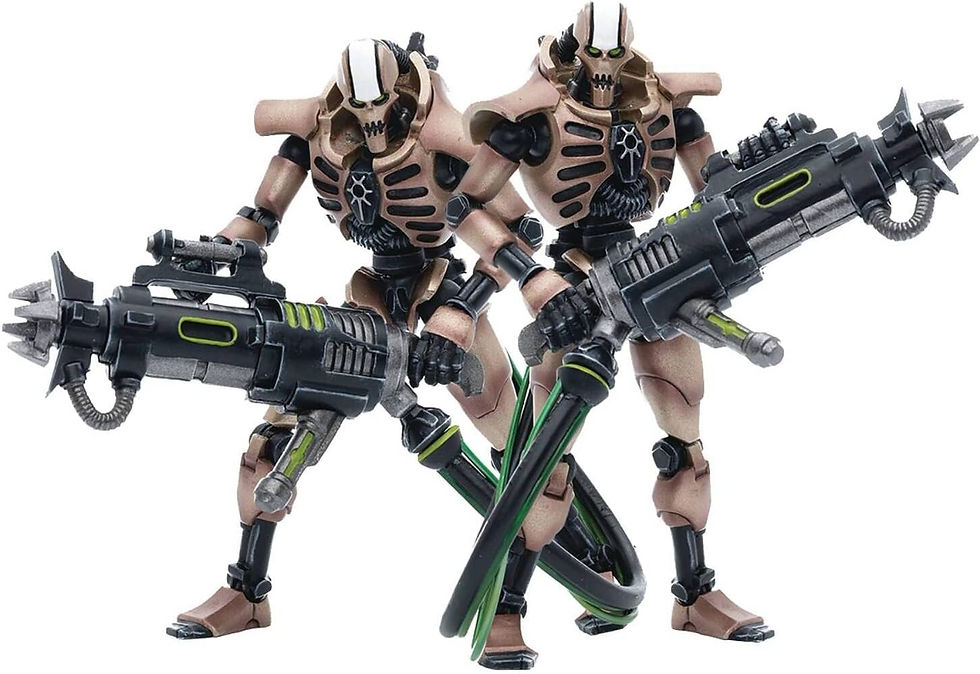
Their Gauss weapons perfectly illustrate this superiority. Rather than merely piercing armour or causing an explosion, they progressively disintegrate their target by stripping away matter atom by atom. Yet this is only a glimpse of their capabilities. Their vessels manipulate space, their pylons can disrupt the Warp, and some of their inventions can slow time, alter the laws of physics, or imprison fragments of cosmic entities. To most other races, these technologies seem more like magic than science.

An instantly recognizable aesthetic
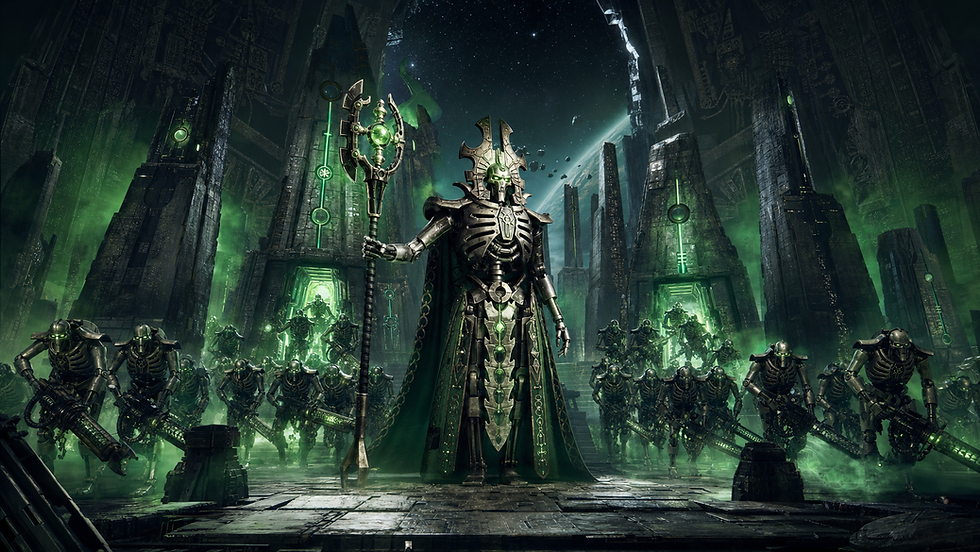
The Necrons possess one of the most striking visual identities in Warhammer 40,000. Their skeletal silhouettes resemble ancient machines emerging from forgotten tombs, while their metal armour, often black or silver, is crossed by a characteristic green glow that powers both their weapons and their own systems. Every miniature conveys a sense of mechanical coldness and perfectly controlled ancient power.
Their architecture also contributes to this identity. Gigantic Monoliths, obelisks, and geometric funerary complexes feel like the remnants of a civilization infinitely older than any other. Unlike the Imperium's Gothic constructions or the Orks' improvised fortresses, Necron structures appear timeless and almost immutable. Everything about their aesthetic reinforces the idea that other species are merely temporary occupants of a galaxy that once belonged to the Necron dynasties.
Necrons on the tabletop: endurance and precision
On the tabletop, the Necrons are best known for their incredible resilience. Thanks to Reanimation Protocols, some destroyed models can return to play, often forcing the opponent to concentrate more firepower in order to eliminate a unit for good. This mechanic perfectly reflects the faction's lore and can make it feel as though you are fighting an army that stubbornly refuses to disappear.
But the Necrons are not defined by endurance alone. They also possess excellent firepower, often enhanced by the Lethal Hits ability, particularly dangerous close-combat units such as Lychguard, Flayed Ones, and Skorpekh Destroyers, as well as iconic vehicles such as Monoliths. This combination of resilience, precision, and advanced technology makes them a methodical army, able to steadily control the battlefield while wearing down the enemy.

A faction with many personalities
Despite their cold, mechanical appearance, the Necrons include some of Warhammer 40,000's most memorable characters. Each pursues goals that extend far beyond present-day conflicts and reflect the millennia-spanning history of their civilization. Trazyn the Infinite roams the galaxy to enrich his vast collection of artefacts and historical figures, while Orikan the Diviner manipulates time to guide destiny according to his calculations. Imotekh the Stormlord seeks to reunify the ancient dynasties, while the Silent King still searches for a way to save his people permanently from the consequences of Biotransference.
These figures give the faction unexpected depth. Behind armies of anonymous warriors stand rulers, strategists, and scientists whose ambitions span millions of years, reminding us that the Necrons are not merely an army of robots, but the survivors of an entire civilization.
Why the Necrons fascinate so many fans
The Necrons hold a unique place in Warhammer 40,000 because they embody a form of power unlike that of any other faction. They do not seek to convert the galaxy to an ideology and are driven neither by faith nor by an endless thirst for destruction. Their goal is much simpler: to reclaim an empire they still consider their own.
This concept is paired with an especially powerful visual and narrative identity. Blending science fiction, ancient Egypt, immortal robots, and cosmic tragedy, the Necrons project a sense of forgotten grandeur rarely matched in the Warhammer 40,000 universe. Beneath their steel bodies are the last representatives of a people who gained immortality at the cost of their humanity, making them one of the game's most fascinating factions.
Necrons: the immortal kings of the galaxy
The Necrons represent one of Warhammer 40,000's oldest, most advanced, and most feared civilizations. Their gradual awakening poses a major threat to every other species, for they still possess weapons and technologies inherited from an age before any present-day civilization existed. Each tomb world that awakens therefore releases a new dynasty ready to reconquer the stars under the command of immortal rulers.
In a galaxy where every faction fights desperately to survive, the Necrons pursue a very different objective. They do not seek to build a new empire, but to reclaim the one they believe they never truly lost. This absolute certainty, combined with their immortality and technological might, makes them one of the most relentless threats in the entire Warhammer 40,000 universe.


Comments