


Roboute Guilliman: the Avenging Son faces the Imperium

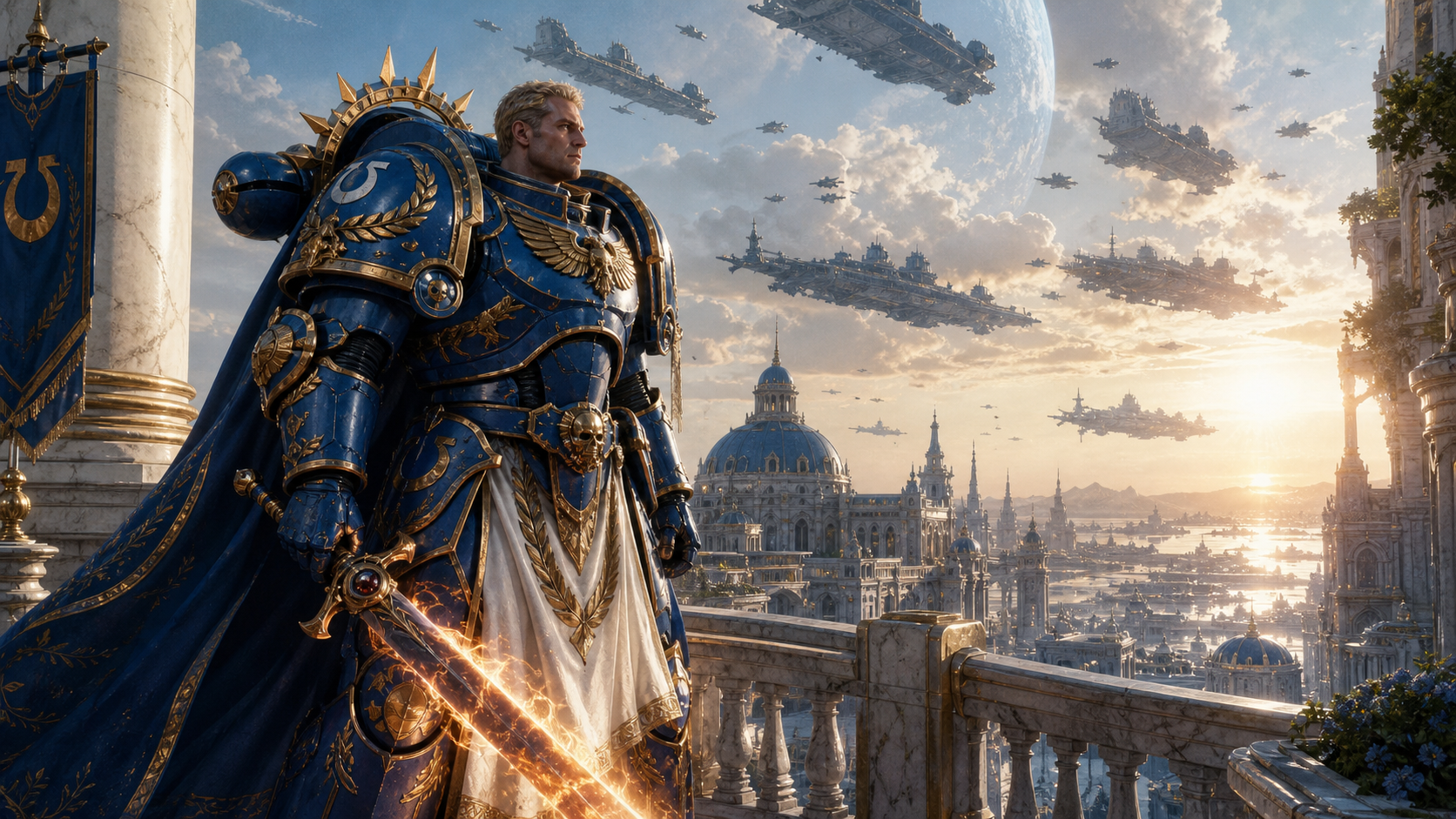
Roboute Guilliman is often summed up in a joke: a Primarch capable of conquering the galaxy with an Excel spreadsheet! The caricature works because it contains an element of truth. Guilliman plans, classifies, delegates, measures and builds. But to reduce the Lord of Ultramar to a superhuman bureaucrat is to forget what organization means in Warhammer 40,000. In the midst of an empire that readily confuses suffering and virtue, making a road passable, feeding a planet and transmitting an intelligible order are almost revolutionary acts.
Guilliman is not the most mysterious of the Emperor's sons. He is neither the wildest nor the most flamboyant. He is the one who wonders what will exist after victory. And when he returns after a coma of ten millennia, he discovers the answer he feared: the Imperium survived, but has forgotten why.
Macragge's child
Like the other Primarchs, Guilliman was torn from the Imperial laboratory and scattered across the galaxy. He arrived on Macragge, a world of mountains, fortified cities and institutions inherited from an older civilization. Konor Guilliman, one of the two consuls on the planet, adopted him and gave him an education as a head of state as well as a warrior.
Very early on, Roboute demonstrated a prodigious intelligence for strategy, logistics and the law. He wasn't content with winning a campaign: he wanted to understand why a province rebelled, how a tax circulated, what an army consumed, and what institution would prevent the next disaster.
This education took a tragic turn when Konor's colleague Gallan staged a coup with the support of aristocrats hostile to the new reforms. Roboute returned from the countryside too late to save his adoptive father. He crushed the rebellion, but Konor's death gave rise to a lasting conviction in him: a society cannot depend solely on the virtue of a great man. It must have rules, checks and balances and structures capable of surviving individual ambitions.
Ultramar: conquer to build
Even before meeting the Emperor, Guilliman had extended Macragge's influence to neighboring worlds. This domain became Ultramar, then later, during the Great Crusade, the Five Hundred Worlds of Ultramar: a remarkably stable, productive and coherent whole on the scale of the Imperium.
Guilliman's conquests were not peaceful in nature. Like all the Primarchs of the Great Crusade, he imposed Conformity in the name of an authoritarian imperial project. Its difference was in the aftermath. Conquered systems were to be given roads, administration, defense, and a place in the larger whole. Victory was not complete until peace could function without the permanent presence of the Ultramarines.
This logic explains the power of the XIII Legion. Ultramar offered him recruits, shipyards, reserves and worlds capable of sustaining a long war. Logistics was not the consequence of its strategy: it was the heart of it.
The Primarch of Systems
Guilliman thinks in networks. Where another general sees a fortress, he sees the convoys that supply it, the data that guides its defenders and the population that gives it meaning. His talent is therefore not simply to predict an opposing movement. It consists of organizing thousands of decisions so that they converge towards the same result.
This ability allows him to command immense forces without requiring mechanical obedience at every moment. Clear doctrine gives a junior officer the means to understand the intent of his superior. The military becomes faster because it doesn't wait for one mind to solve every problem.
This is also Guilliman's weakness: he deeply believes that problems can be made intelligible. Faced with the Warp, prophecies and passions that defy causality, its need for structure can become a vulnerability. He knows how to revise a plan, but has difficulty accepting that an entire universe sometimes refuses to be reasonable.

Calth: when reason meets madness
At the start of the Horus Heresy, Guilliman was ordered to concentrate his Legion at Calth for a campaign alongside the Word Bearers. The operation was actually a trap. Lorgar, the Primarch of the Word Bearers, launched a surprise attack aimed at mutilating the Ultramarines and isolating Ultramar from the rest of the galaxy.
Calth is one of those crucial moments that forged Roboute Guilliman. The methodical Primarch faced a betrayal planned with religious hatred he could not have anticipated. His first reaction was not cold, but deeply personal. However, he managed to transform this anger into adaptation. The shattered Ultramarines rebuilt their chains of command and regained the initiative on a battlefield transformed into a nightmare by the forces of Ruin.
The lesson was bitter. Even a perfect system cannot protect itself from someone who destroys it just to watch the world burn. After Calth, Guilliman's rationality was purified of a certain naivety.
Imperium Secundus: foresight or sin?
The Storm of Ruin cut Ultramar off from Terra. Without reliable communications and believing the fall of the Emperor possible, Guilliman founded Imperium Secundus in order to preserve human authority and continue the war. He did not crown himself emperor. He made his brother Sanguinius the symbolic ruler, while he organized this new ensemble alongside Lion El'Jonson.
This decision remains one of the character's most fruitful gray areas. On a practical level, it is defensible: waiting passively could doom hundreds of worlds. Politically, creating a second Imperium risked legitimizing exactly the fragmentation unleashed by Horus.
Guilliman did not betray the Emperor, but he did reveal a trait dangerous to the Imperium: when one central structure fails, he would be able to build another. And his expertise in the matter only makes this prospect all the more frightening.
The Codex Astartes: preventing a new Horus
After the Heresy, the Imperium was in ruins and the Legiones Astartes still concentrated immense military power. Guilliman therefore wrote the Codex Astartes and imposed the division of the Loyalist Legions into smaller Chapters. The objective was clear: no Space Marine leader should ever again command a force sufficient to provoke a second civil war of the same magnitude.
The Codex is sometimes represented as a rigid book that contains an answer for each battle. However, it is more interesting to consider it as a doctrine architecture, encompassing organization, roles, cooperation and adaptable principles. Guilliman's successors often made it a sacred text, transforming a tool for reflection into orders to be followed to the letter.
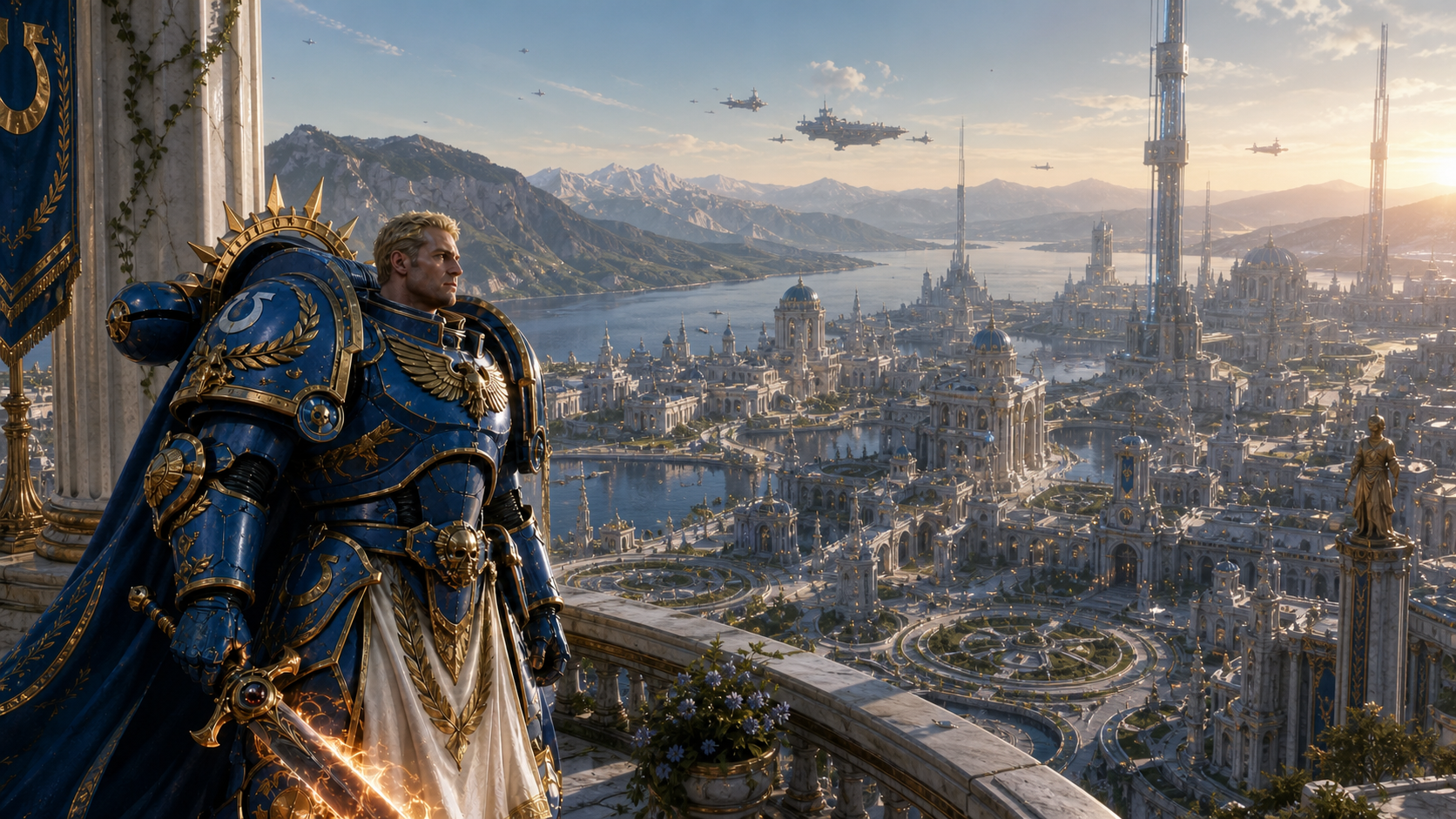
This irony runs through its entire history. Guilliman writes the Codex to make warriors able to think without it; ten thousand years later, some invoke his words to avoid thinking.
Fulgrim, a deadly blade and ten millennia of silence
During the Great Purge that followed the Heresy, Guilliman faced his brother Fulgrim. The Primarch of the Emperor's Children mortally wounded him with a poisoned blade. Unable to save him, the Ultramarines placed their genetic father in stasis on Macragge.
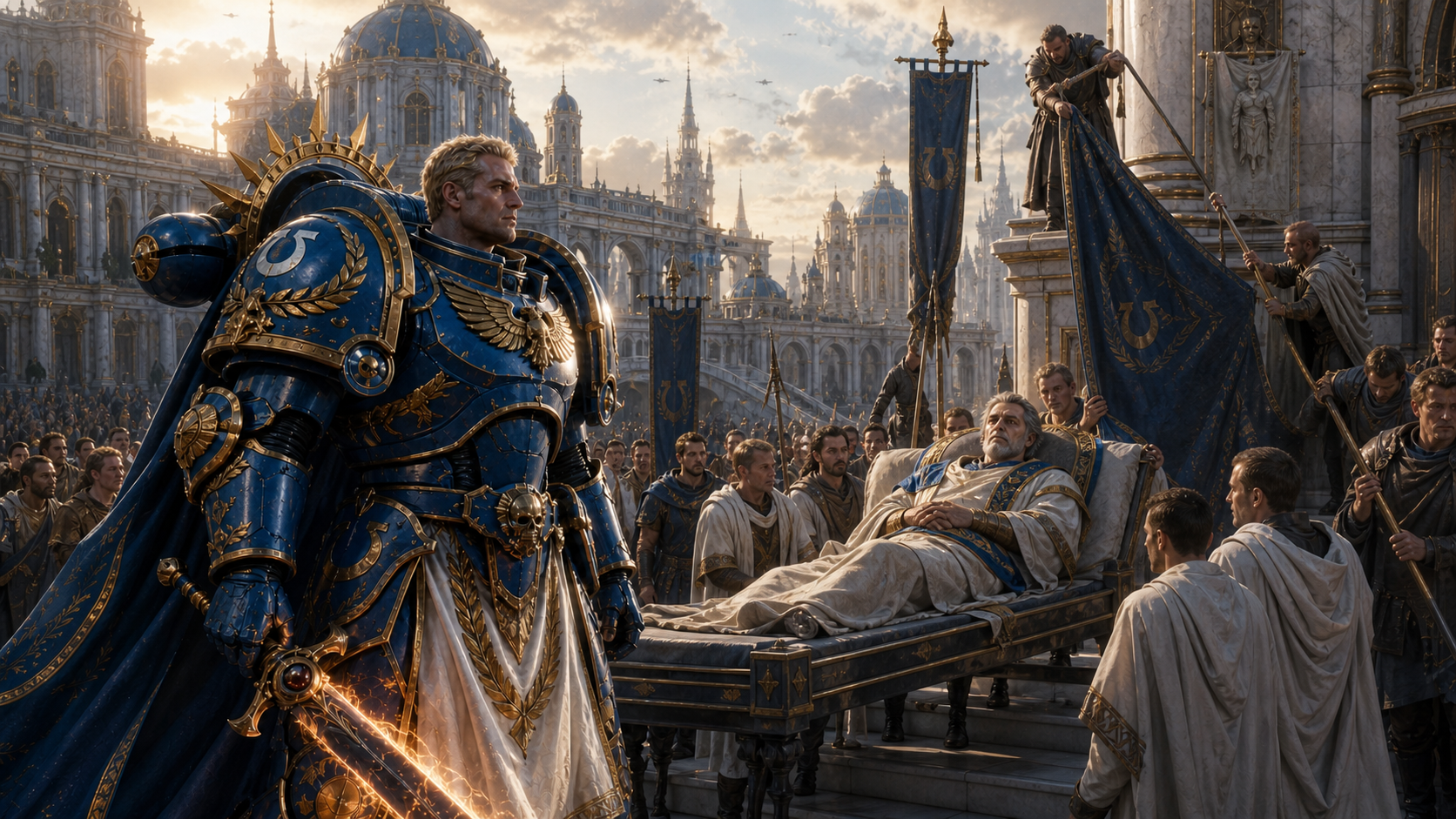
He then became a living relic, frozen forever in this moment of defeat. Generations of pilgrims came to contemplate the one who, for them, already belonged to mythology. Meanwhile, the Imperium built institutions in its name and implemented policies it often did not approve of.
And this absence is as important as his return. Indeed, for ten millennia, Guilliman was unable to correct, clarify or contest the use of his heritage. The Codex became dogma, the Primarch became a saint and the Emperor became a god.
Awakening of the Vengeful Son
The fall of Cadia and the opening of the Great Rift plunged the Imperium into an existential crisis. On Macragge, an unlikely alliance allowed the awakening of Guilliman: Belisarius Cawl, Saint Celestine and Yvraine of the Ynnari played essential roles. The Armor of Destiny, designed by Cawl, took over the systems that kept him in stasis and allowed the Primarch to rise in the midst of a Black Legion attack.
His awakening, however, is not a triumphant return to a familiar world. It is a resurrection into a monstrous future. The Imperium celebrates the Emperor, its father, as a deity; the administration is overwhelmed by its own archives; technology is ritualized; and entire institutions thrive on fear.
Guilliman, however, receives the title of Lord Commander of the Imperium. He cannot reject this civilization which seems to have distorted and brutalized each of its principles: despite its horrors, it still shelters the humanity he wants to protect.
Governing an empire he hates
The great current conflict that is agitating Guilliman is not only military. He must use the myths he despises. Billions of humans see him as the son of a true god. If he brutally denies their faith, he can fracture the Imperium; if he exploits it, he participates in a lie.
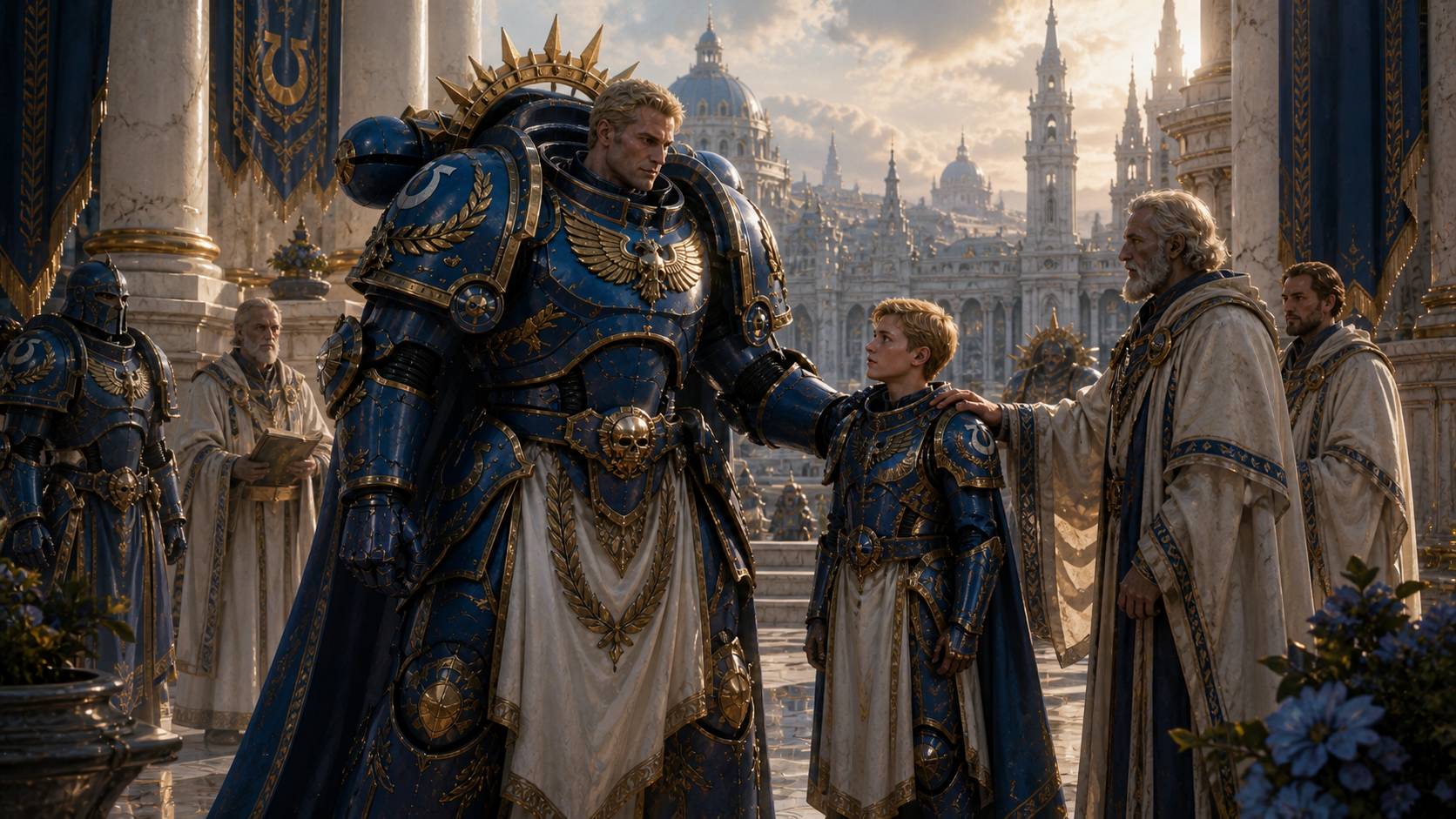
This tension gives the character a tragic dimension. He has enough power to understand the catastrophe, but not enough to repair it without risking destroying everything. He replaces certain officials, reforms administrations, punishes abuses and revives institutions. Yet every improvement depends on huge, slow, and often hostile structures.
The master of the organization thus finds himself a prisoner of the largest dysfunctional system in human history.
The Indomitus Crusade
Faced with the Great Rift, Guilliman chooses action. It brings together the Indomitus Crusade, a gigantic mobilization that brings together the Astra Militarum, the Imperial Navy, the Adeptus Mechanicus, the Adeptus Custodes, the Space Marines and their new Primaris forces. This endeavor isn't just about winning battles: it's also about mapping a galaxy in turmoil, reestablishing shipping routes, liberating worlds, and restoring a chain of command.
The Primaris of Cawl embody both a solution and a risk. They offer essential reinforcements, but their existence is based on a ten thousand year old project carried out with worrying autonomy. Guilliman accepts this new tool, because the alternative would be the total collapse of the Imperium.
The Crusade perfectly illustrates his genius: transforming a multitude of incompatible armies into a force capable of embarking on a common strategic effort. She also reveals her burden. For every world he decides to save, others disappear behind the Rift.
The Plague Wars and the return of the supernatural
When his brother Mortarion and the Death Guard strike Ultramar and the 500 Worlds, Guilliman must defend the domain that best embodies his ideals. The war then becomes a confrontation between two visions of the world: the perfectible order of Guilliman and the infectious fatalism of Nurgle.
On Iax, the conflict takes on a metaphysical dimension. Guilliman is drawn into the Garden of Nurgle, deep in the Warp, and survives what would destroy him, as a power that some associate with the Emperor manifests through him. For a rationalist, this experience is unbearable: the existence of the Chaos gods does not automatically make imperial theology true, but it now prevents any rejection of the divine.
Guilliman therefore continues to act in uncertainty. Is he protected by his father, used as an instrument or manipulated by forces he does not understand? His great intelligence will not provide him with any clear answers and will, on the contrary, only be a source of torment.

A father for the Ultramarines, a problem for the Imperium
For the Ultramarines, the return of their Primarch is a blessing that can nevertheless provoke an identity crisis: they have spent ten millennia interpreting his heritage, and now he is able to tell them how much they have misunderstood him all that time.
Guilliman does not want his sons to turn into automatons. It values discipline because it allows coordinated action, not because it suppresses initiative. His return therefore pushes the Ultramarines to distinguish living tradition from sterile repetition.
On an Imperial scale, it is even more disturbing. His legitimacy exceeds that of all human leaders who have reigned up to that point, but his existence contradicts the narratives that have supported their authority. He is both the heir of the system and living proof of the deformation of its institutions.
Its limits: control, pride and compromise
Guilliman is not a modern Democrat lost in the future. He is a giant genetically engineered for conquest, convinced that a competent elite can rule in the name of the common good. Its institutions are more humane than many imperial alternatives, but they still rely on force and a near-absolute hierarchy.
His talent also feeds his pride. Because he solves impossible problems, he may underestimate the blind spots in his own thinking. His conflicts with certain brothers, the Imperium Secundus and his confidence in great political architectures show that he is not immune to error.
Finally, every compromise with the Ecclesiarchy, the Mechanicus or repressive institutions may save the Imperium today, but consolidates what it would like to be able to change tomorrow.
Why Guilliman became essential to Warhammer 40,000
Guilliman appears as a reasonable man confronted with an unreasonable civilization. Thanks to him, the reader becomes aware of the gap between the proclaimed ideal of the Great Crusade and the reality of the 41st millennium. His gaze makes the Imperium stranger without making it lose its grimdark character.
He cannot restore the golden age, because it was never as pure as the memory he keeps of it. Nor can he abandon the Imperium, for hundreds of billions of lives would then be surrendered to Chaos and the predators of the galaxy. He must therefore build a better future with materials that he considers rotten.
The great drama of Roboute Guilliman is not whether he can win the next war. It is whether the order he defends is still worth saving, and whether it is possible to save him without becoming exactly the enlightened tyrant that history hopes to make him.
Sources and playback tracks
Warhammer Community — “40 Years of Warhammer — The First Loyalist Primarch in Warhammer 40,000”
Warhammer Community — “Three Times Roboute Guilliman Triumphed Using the Power of Careful Project Management”
Warhammer Community — “5 Times The Imperium Would Have Been Doomed Without Roboute Guilliman”
Warhammer Community — official extract “The Ultramarines”, The Horus Heresy: Book Five — Tempest
Warhammer Community — “Ultramar’s most iconic planets revealed”
Warhammer Community — “The Hand of Abaddon Makes a Move in the Penultimate Dawn of Fire Novel”
Warhammer Community — “The Dawn of Fire saga continues this month in The Gate of Bones”


Comments