


Varro Tigurius: the psychic eye of the Ultramarines

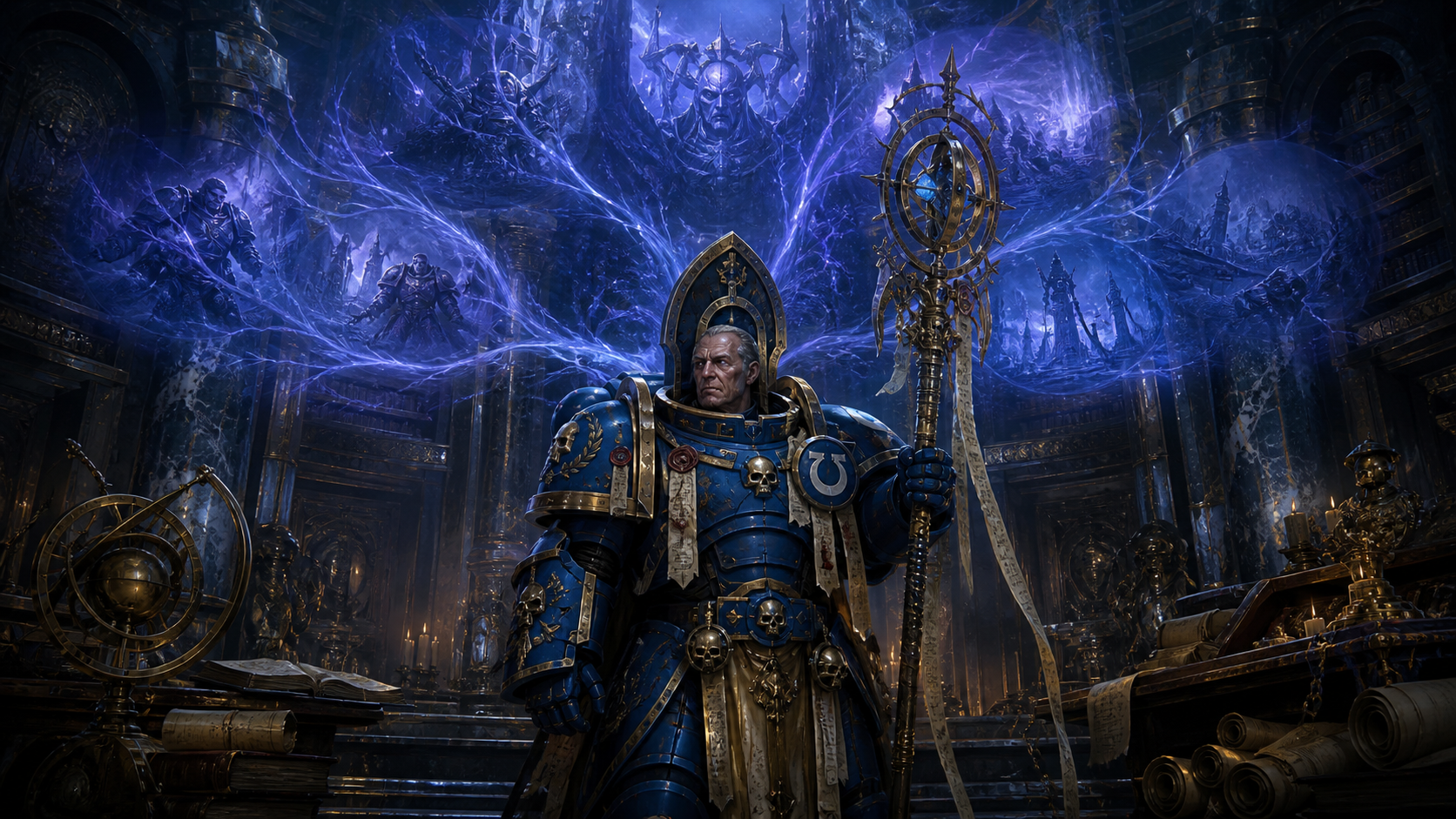
Among the Ultramarines, war must be understood before it is fought. Strengths are listed, objectives defined, risks classified. Varro Tigurius is the man responsible for studying that which precisely refuses any classification: the Warp, the visions and the thoughts of enemies whose minds have nothing human.
Master Archivist of the Ultramarines, Tigurius is not only a Space Marine capable of projecting psychic power. Its real importance comes from its role as interpreter. He perceives possible futures, detects presences across the immaterium, and advises commanders who must decide whether a vision is a warning, a trap, or both.
In a Chapter associated with reason and doctrine, Tigurius represents the part of the unknown that even the Codex Astartes cannot abolish.
What is a Space Marine Archivist?
Archivists are the psykers of the Adeptus Astartes. They develop their powers while maintaining the martial discipline, physical resistance and indoctrination of a Space Marine. Their function is not limited to combat: they preserve the Chapter's archives, study occult threats, interpret omens and protect their brothers against mental attacks.
This role is dangerous by nature. The Warp is a dimension of thought, emotion and predation. Using your energy is opening a door to an ocean where something can lie in wait for you from the depths. Power is therefore not enough. An Archivist must control his ego, recognize manipulation and close the passage before it consumes him.
The title of Master Archivist places Tigurius at the top of this institution among the Ultramarines. He supervises the Librarius, advises the Chapter Master and intervenes when conventional weapons cannot explain the threat.
An Ultramarine facing the irrational
Tigurius is fascinating because he belongs to the Chapter most associated with the method. He does not reject this culture: he applies it to the impossible. His visions do not automatically become truths. They must be compared, placed in context and translated into military decisions.
Precognition does not offer a certain scenario. In the Warhammer 40,000 universe, the future is a shifting web of possibilities influenced by the Warp, the choices and interventions of other seers. Seeing a disaster can help you avoid it; avoiding it can lead to a different disaster. A useful insight must therefore remain a hypothesis until other evidence reinforces it.
This prudence distinguishes Tigurius from the sorcerer convinced that his power places him above all error. His ultramarine discipline does not remove the mystery, but it provides him with a method to avoid drowning in it.
The eye of the future
Tigurius' reputation rests largely on his prescience. It can anticipate a maneuver, warn of a catastrophe or spot the moment when a situation changes. On a battlefield, a few seconds of advance allows you to reposition a squad, protect a commander or concentrate fire on a threat that is not yet visible.
On a strategic scale, the problem becomes more complex. The more a vision extends over time, the more the variables multiply. The Master Archivist therefore does not always provide a clear prophecy to his superiors. It sometimes brings an impression, a symbol, a glimpsed death or the certainty that an apparently safe road leads to a trap.
His talent lies as much in interpretation as in perception. A clairvoyant unable to explain what he has seen is a curiosity. Tigurius transforms intuition into actionable intelligence.

The price of vision
Heroic fiction easily presents precognition as an unrequited advantage. For Tigurius, every glance into the Warp is an exposure. The emotions and wills that inhabit it are not passive. They can hide a route, imitate a presence or present to the seer exactly the image that will lead him to make an error.
The cost is also human. Knowing about possible death does not mean being able to prevent it. A commander may have to choose between saving a hero and preserving a planet. The clairvoyant then bears a particular responsibility: if he speaks, his vision modifies decisions; if he remains silent, he decides regardless.
Tigurius therefore lives at the meeting point between knowledge and guilt. Her calm is not the absence of fear, but a discipline built to act in spite of herself.
The war against the Tyranids
The Ultramarines have had a traumatic history with the Tyranids since the invasion of Macragge by the Hive Fleet Behemoth. Faced with this enemy, Tigurius' talent takes on an almost impossible dimension.
Tyranid organisms are connected by a synaptic network dominated by the Hive Mind. Their presence generates the Shadow in the Warp: a psychic pressure that disrupts communications, stifles perceptions, and overwhelms sentient minds. Where an ordinary psyker would lose his bearings, Tigurius is said to be able to discern something within this din.
This should not be presented as a simple conversation with the Hive Mind. Tyranid intelligence is distributed, alien, and on an unimaginable scale. The stories of Tigurius facing Leviathan precisely emphasize the danger of this proximity. To perceive the enemy means to risk being perceived by him.
Understanding an intelligence that is not a person
The Hive Mind poses a philosophical problem as much as a military one. Human commanders normally seek a leader, doctrine, or individual intent. Among the Tyranids, will circulates through billions of organisms. Destroying a decisive creature can disorganize a local swarm without killing the intelligence that produced it.
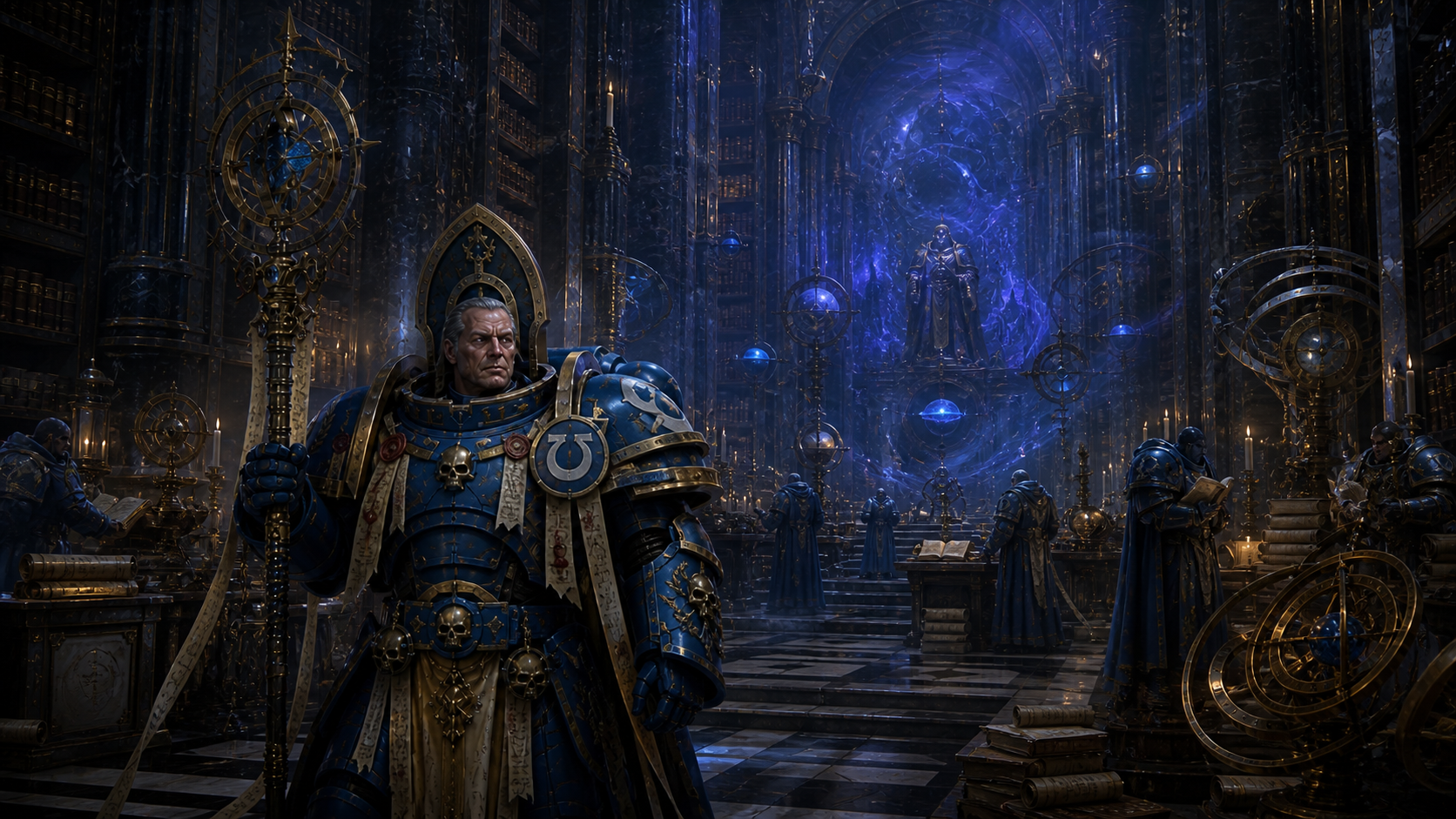
Tigurius can provide a mental model of this threat: not an empire that conquers, but a hunger that learns. Each defense reveals biological information. Each effective weapon pushes the adversary to produce an adaptation.
The value of the Master Archivist then is to recognize patterns in colossal psychic noise. He doesn't "read" the Hive Mind like he would a human. It detects a pressure, a direction, a concentration of will — enough to warn that the visible mass may only be a distraction.
Damnos: the prophecy among the machines
On Damnos, the Ultramarines confronted the Necrons awakened beneath the surface of the world. Tigurius accompanied Cato Sicarius and received a vision announcing the death of a hero. The story highlights one of its fundamental dilemmas: how to command when we know that a sacrifice seems to be in the future?
The Necrons are a very different adversary to the Tyranids. Their technology, their lack of soul in the human sense and their age-old protocols complicate psychic reading. The battlefield thus opposes two forms of coldness: the mechanical logic of a dead civilization and the discipline of a seer obliged to interpret the inevitable.
When Sicarius is put out of action, the Ultramarines rally around Tigurius. The Master Archivist does not remain an advisor behind the command; he assumes operational responsibility and attempts to transform a predicted defeat into survival.
Tigurius as warlord
A spectacular psyker can draw all the attention to its lightning bolts and energy barriers. Tigurius is most interesting when he is leading. His prescience allows him to order a move before the threat appears, but the trust of his brothers is just as important.
This trust is not automatic. Even among Space Marines, psykers inspire particular caution. The Ultramarines follow Tigurius because his visions have been tested by experience, because he knows the Codex, and because he shares the risks he asks them to accept.
He thus demonstrates that a supernatural ability does not replace command. It only becomes useful if it is integrated with doctrine, communications and a precise understanding of the units available.
The Hood of Hellfire and the Staff of Tigurius
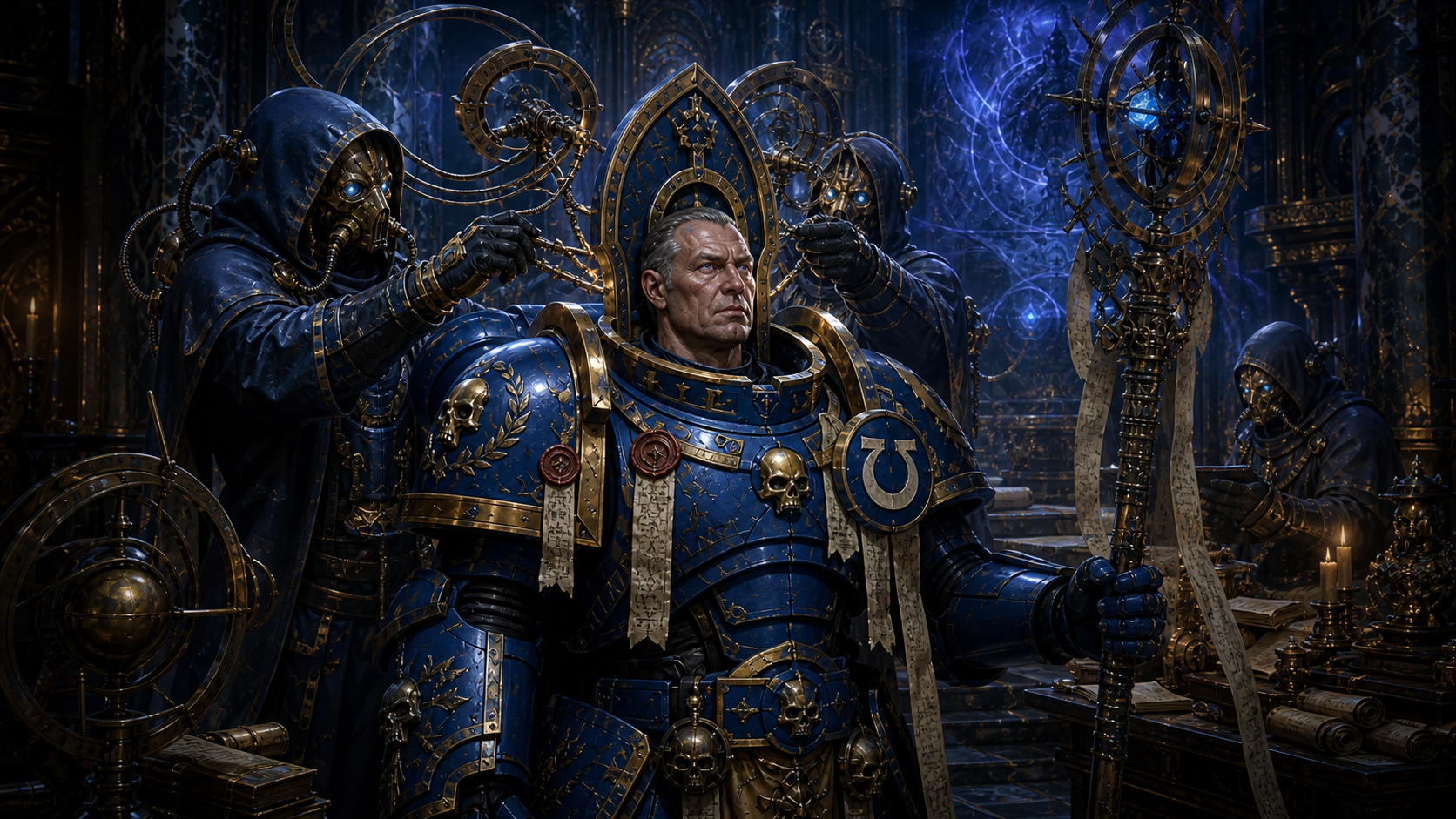
The modern silhouette of Tigurius combines the iconography of the Archivist and that of a Primaris veteran. His psychic headdress, often associated with the name Hood of Hellfire, serves to channel his perceptions and protect him from the attacks of the Warp. His force staff allows him to focus his psychic energy, while his armor bears the marks of the Librarius and Ultramar.
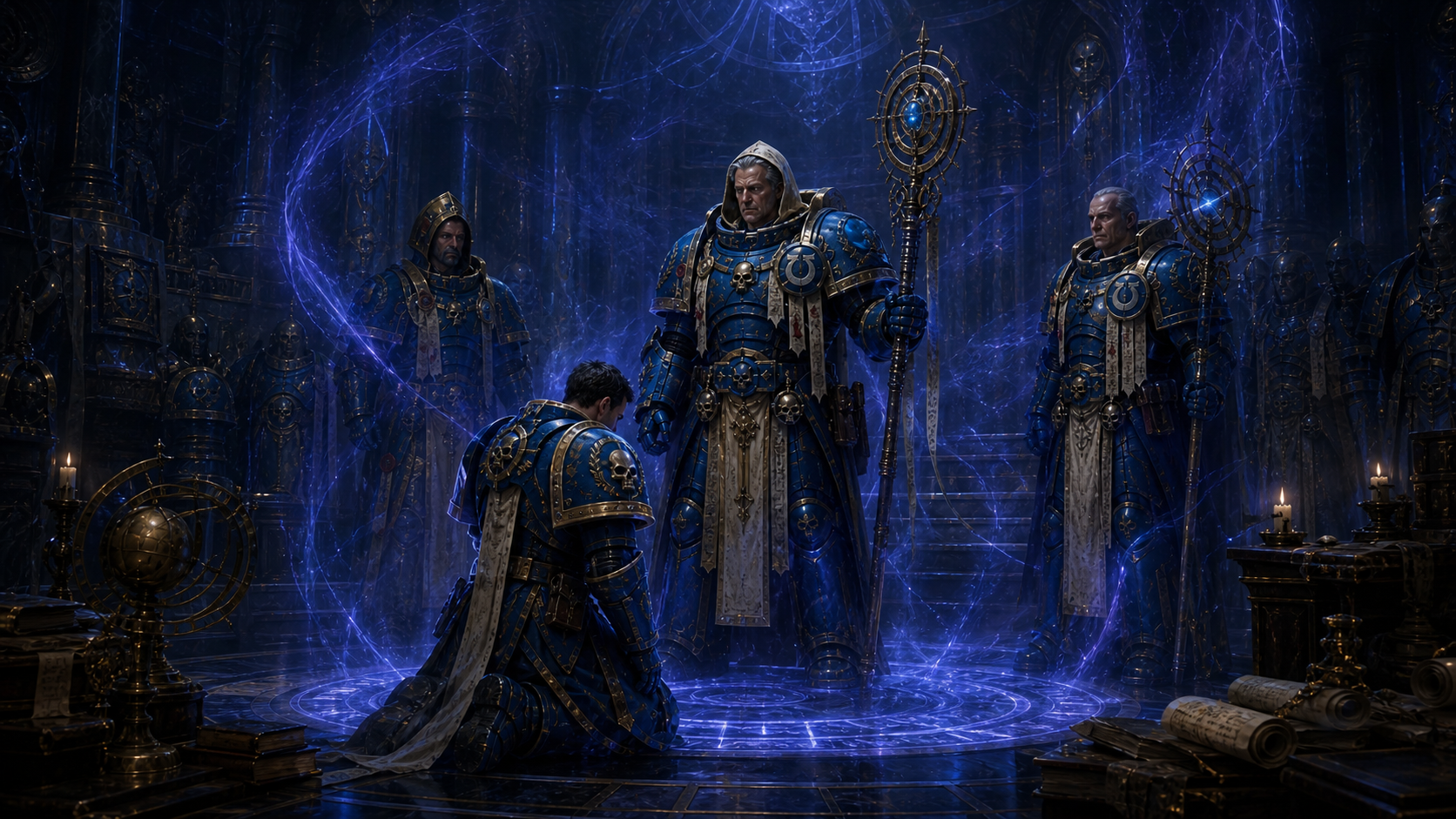
These relics are not simple amplifiers. They materialize a fundamental idea of the Imperium: dangerous power must be locked within rites, symbols and devices of control. At Tigurius, this confinement does not stifle talent; it allows it to survive its use.
Visually, he therefore stands out from the Ultramarines captains. The blue remains, but the scrolls, headdress, skull and staff represent a man who fights as much in the material world as in that of thoughts.
The transition to Primaris status
Tigurius crossed the Rubicon Primaris, a risky transformation that increased his physical capabilities and integrated him into the new generation of Space Marines. For an already exceptionally powerful character, this passage has symbolic significance.
The keeper of the Ultramarines' psychic traditions accepts a radical innovation. This choice best represents the vision of the Chapter: the Codex is not a refusal of change, but a method for framing it.
This transformation does not change the main danger. Stronger muscles and more advanced armor do not fully protect against a Tyranid intelligence or Warp entity. Tigurius' most important battle remains mental.
Finding Titus in the Shadows
A recent episode links Tigurius to the return of Demetrian Titus. As the Shadow in the Warp blurs his perception, the Master Archivist recognizes the spiritual signature of this warrior, once captain of the Second Company. He orders that the injured Black Shield be brought back on board rather than abandoned.
This gesture sums up his role. Tigurius sees what others cannot see, but vision is not enough: he makes a decision that engages his authority and opens the possibility of reintegration.
This episode also reminds us that his clairvoyance concerns people, not just military movements. He recognizes a continuity of identity beneath the scars, beneath the silence and behind an abandoned name.

Prophet or analyst?
The word “prophet” does not suit Tigurius if it implies a revealed and incontestable truth. He's more like an analyst working with the most dangerous intelligence source in the galaxy. His data is fragmentary, hostile and sometimes conscious of being observed.
This comparison helps us understand his place among the Ultramarines. Guilliman and the Codex value preparation, but no plan survives without information. Tigurius provides what auspexes, spies, and maps cannot: insight into psychic intentions and possibilities.
However, he remains subject to the same imperative as any serious analyst: to distinguish what he knows, what he believes and what an enemy force wants him to believe.
The limits of a too powerful hero
Tigurius's reputation is so great that it risks harming the stakes of the stories in which he appears. If the seer understands the trap and still has the power to escape it, the suspense disappears. The best stories therefore emphasize three of its limitations.
First, the vision is ambiguous. Then the enemy can watch back. Finally, knowing does not mean having the necessary strength to act. Tigurius may know where to strike and still be forced to send brothers to probable death.
These constraints prevent it from becoming a miracle solution. They make him a tragic character: he who sees more also bears more responsibilities.
Does Tigurius deserve the attention he gets?
Tigurius is sometimes eclipsed by the more immediately spectacular figures of the Ultramarines: Guilliman, Calgar, Sicarius or Titus. However, it embodies a central question of the Chapter. What happens to doctrine when it is confronted with the unpredictable?
His response is neither denial nor abandonment to mysticism. He observes, doubts, interprets and acts. His psychic power is extraordinary, but his most remarkable quality remains the discipline with which he refuses to confuse power and certainty.
In a galaxy where emotions can become monsters and collective intelligence can overwhelm entire sectors into silence, Varro Tigurius is the open eye in the storm. It does not promise that the future can be controlled. It offers something more valuable: the ability to look at it without looking away.
Sources and playback tracks
Warhammer Community — “Who is Lieutenant Titus?” The long and glorious history of the Space Marine 2 hero »
Warhammer Community — Combat Patrol Ultramarines, “Eye of Ultramar”
Black Library — Nick Kyme, “Fall of Damnos”
Black Library — Josh Reynolds, “Shadow of the Leviathan”
Black Library — Nick Kyme, “Spear of Macragge”
Black Library — “Legends of the Dark Millennium: Ultramarines”
Warhammer Community — “Unleash the Shadow in the Warp With the Neurotyrant”


Comments