


Astra Militarum: Man Against the Horrors of the Galaxy

Updated: Jul 15

In the universe of Warhammer 40,000, the Space Marines often steal the spotlight. They are genetically modified warriors, wrapped in almost indestructible armor and capable of facing, alone, horrors pulled straight from humanity’s darkest nightmares. And yet, when worlds are invaded by Orks, Tyranids, Necrons, or the armies of Chaos, they are rarely the ones who have to hold the first line. That role belongs to the Astra Militarum.
These men and women are neither superhumans nor the Emperor’s chosen. They are soldiers, ordinary humans armed with lasguns, helmets, and a quantity of courage that sometimes borders on madness. The Astra Militarum is not only the largest army of the Imperium. It is proof that humanity continues to fight, even when it has almost no chance of winning, with or without demigods to guide it.
The Immense Army of the Imperium
The Imperium is made up of millions of worlds scattered across the galaxy. Each planet has its own defense forces, but when a war exceeds local capabilities, the Astra Militarum is called in. Unlike the Space Marines, who are extremely rare, the Imperial Guard fights everywhere.
Hundreds of billions of soldiers serve under its banners. Some are born on industrial worlds, others on frozen planets, desert worlds, agricultural planets, or worlds entirely dedicated to war. All are gathered under the same banner: to defend the Emperor and preserve the Imperium, whatever the cost.
This immense scale makes the Astra Militarum a military machine without equal. Where a Space Marine Chapter may save a planet through a surgical strike, the Imperial Guard often wins through attrition, numbers, and a gigantic logistical chain.

An Army of Men... Facing Monsters
This is probably what makes the Astra Militarum so fascinating. A Space Marine can survive wounds that would instantly kill a human. A Guardsman, however, remains a simple human being. He feels fear. He can die from a single shot. He knows the enemy is often far stronger than he is. And yet, he advances.
Imagining a line of infantrymen holding their position against a charge of Orks, a Tyranid Carnifex, or a Greater Daemon immediately gives you a sense of what the Astra Militarum truly represents. The hero is not the one who feels no fear. The hero is the one who continues despite the fear.
It is this deeply human dimension that sets this faction apart from almost every other army in Warhammer 40K.
The Strength of Numbers
The Imperial Guard does not try to win through a handful of elite warriors. It wins through colossal military power. Entire regiments can be sacrificed to slow an enemy advance. Thousands of tanks can be committed to a single front. Artillery batteries can bombard a region for days before the infantry even begins to move.
This way of waging war may seem brutal, but it perfectly reflects the philosophy of the Imperium: a world may be lost, a regiment may be destroyed, but humanity itself must survive. For many Imperial commanders, a soldier is a precious resource. But for a structure as vast as the Imperium as a whole, he is often little more than a statistic.
Regiments with Unique Identities
Contrary to what one might think, the Astra Militarum is not a uniform army. Each world recruits and trains its soldiers according to its own traditions. The famous Cadians embody absolute military discipline. The Catachans have become survivors capable of facing jungles where even the smallest plant can kill a man.
The Death Korps of Krieg represent sacrifice pushed to its extreme, ready to die without hesitation if duty demands it. The Attilans still fight on horseback on worlds where modern warfare exists alongside traditions thousands of years old.
This diversity gives the faction enormous personality. Two Astra Militarum armies can have completely different styles while still serving the same Imperium.

Tanks, the True Heroes of the Guard
If there is one machine that symbolizes the Astra Militarum, it is the Leman Russ. Massive, rugged, and designed above all to be reliable, this tank has accompanied the Imperial Guard for millennia. It is neither the fastest nor the most sophisticated armored vehicle in the galaxy, but it perfectly embodies the Imperium’s military philosophy: advance no matter the cost. Where more modern vehicles rely on precision or advanced technology, the Leman Russ inspires confidence through its ability to keep fighting despite damage, bombardment, and the collapse of the lines around it. In the lore, it is not rare to see these tanks continue their advance even when the rest of the front has already fallen apart.
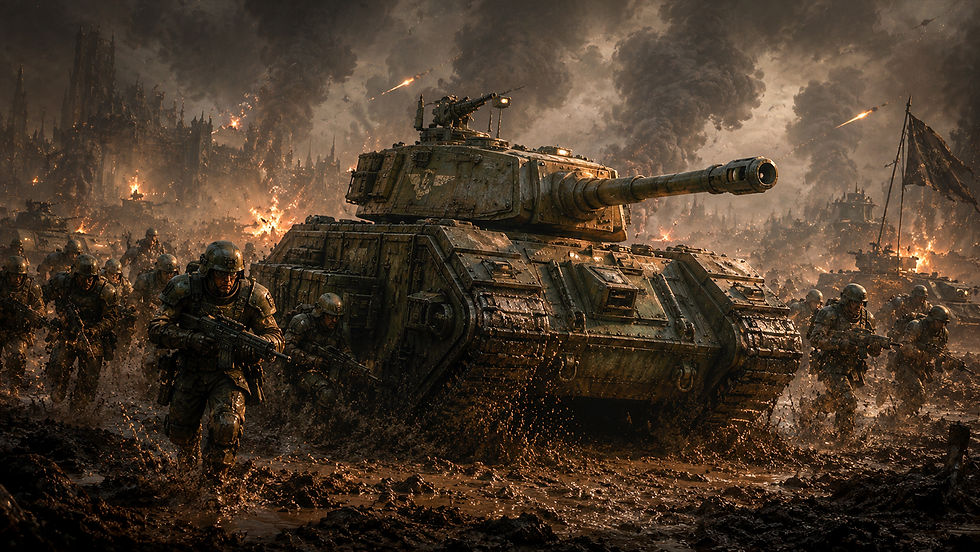
Alongside them roll even more impressive steel monsters, such as Baneblades. True mobile fortresses, these super-heavy tanks concentrate enough firepower to transform an entire battle. Their mere presence is often enough to restore hope to the defenders or break the momentum of an enemy offensive. Where other factions rely on specialized or highly mobile vehicles, the Astra Militarum prefers overwhelming armored force, capable of shelling the enemy until there is nothing left to conquer.
Commissars: Holding the Line at Any Cost
It is impossible to talk about the Imperial Guard without mentioning Commissars. Far more than simple officers, they embody the absolute authority of the Imperium within its regiments. Their role is to maintain discipline, remind every soldier of his duty to the Emperor, and ensure that fear never overcomes the mission. In an army made up of ordinary humans who face the galaxy’s worst horrors every day, this presence is considered essential.
Commissars are especially famous for their most radical method. When a soldier abandons his post or threatens to drag his comrades into panic, they may execute him on the spot to prevent a full rout. This image has become one of the most recognizable symbols of Warhammer 40,000. It perfectly sums up the ruthless logic of the Imperium: the survival of humanity comes before the life of any individual, and one immediate sacrifice may be preferable to an entire army in flight.
A Deeply Military Aesthetic
The Astra Militarum has an immediately recognizable visual identity, largely inspired by the great armies of the twentieth century. Uniforms, helmets, backpacks, bayonets, armored vehicles, artillery batteries, and long infantry columns evoke both the world wars and modern industrial conflicts. Unlike the Space Marines and their futuristic knightly appearance, the soldiers of the Guard look first and foremost like military personnel sent into a war far beyond them.

But as always in Warhammer 40,000, everything is pushed to excess. Tanks become gigantic, cannons take on absurd proportions, cathedrals are transformed into fortresses, and battlefields stretch across entire continents. This aesthetic blends military realism with the gigantic scale of the 41st millennium, giving the Astra Militarum a unique identity where the wars of the past meet the darkest science fiction.
The Astra Militarum on the Tabletop: Numbers, Armor, and Firepower
On the tabletop, the Astra Militarum offers an experience very different from that of the Space Marines. Here, victory does not depend on a few elite warriors capable of accomplishing everything alone, but on the coordination of a true army. Infantry squads hold the ground, secure objectives, and protect the most valuable elements of the force, while tanks and artillery provide the firepower needed to break enemy lines.
An Astra Militarum army can field several Leman Russ tanks, Rogal Dorn tanks, Baneblades, or numerous artillery pieces capable of bombarding the enemy from long range. This combination of infantry, armor, and heavy support often gives the impression of commanding a real military operation. Players who enjoy positioning, unit synergy, and large-scale battle plans usually find the Imperial Guard one of the most satisfying armies to play.

An Ideal Faction for Telling Stories of War
Few factions lend themselves as well to narrative campaigns as the Astra Militarum. Every regiment has its own history, traditions, and heroes, allowing for an endless variety of conflicts. A garrison can hold a hive city for years against a Chaos invasion, an armored company can launch a desperate counteroffensive, or a handful of survivors can sacrifice themselves to allow the evacuation of an entire population before the Tyranids arrive.
These stories work so well because they do not feature invincible warriors, but ordinary men and women facing extraordinary situations. Astra Militarum stories are above all stories of sacrifice, comradeship, discipline, and endurance. They remind us that, in the universe of Warhammer 40,000, true heroism often means holding a position for just a few moments longer, even when everything already seems lost.

Why Fans Love the Astra Militarum
The Astra Militarum holds a special place in Warhammer 40,000. While almost every other faction possesses extraordinary abilities — psychic powers, unimaginable technology, mutations, superhuman strength, or immortality — the Imperial Guard relies essentially on human beings. Men and women who know perfectly well that they are outmatched by the creatures they face, but who still climb into the trenches when the orders are given.
It is precisely this fragility that makes the faction so compelling. Every victory feels earned, every survivor feels as though they have defied the impossible, and every battle reminds us how insignificant humanity is in the face of the threats surrounding it. The Astra Militarum does not triumph because it is the most powerful army in the galaxy. It triumphs because it continues to fight tirelessly, no matter the losses.
Astra Militarum: The Last Shield of Humanity
The Astra Militarum is probably neither the most spectacular nor the most mysterious faction in Warhammer 40,000. And yet, it may be the one that best embodies the spirit of the setting. It represents billions of anonymous soldiers who, every day, take up arms against enemies infinitely more powerful than themselves. Regiments fall, worlds are lost, offensives fail, and victories are always paid for in blood, but the Imperial war machine continues to advance.
In a universe dominated by demigods in power armor, immortal daemons, and ancient alien civilizations, the Imperial Guard reminds us of one simple idea: the fate of humanity still rests on ordinary men. As long as one soldier remains to hold his lasgun, one crew remains to drive its tank forward, or one officer remains to give the order to advance, the Imperium may still hope to survive.


Comments